
GI Microbiome Add-On

Add parasite detection to the GI Microbiome Panel. No additional sample.

For canine and feline GI cases, VDI’s Parasite Add-On extends the microbiome workup with NGS-based parasite analysis using the submitted stool sample.

Dogs & cats Test code 740p NGS-based analysis Add within 1 month
VDI Test Code
740p
Parasite
Add-On
✓
No additional collection Uses the stool submitted for the GI Microbiome Panel.
✓
Add it up to 1 month later Request 740p with the initial submission or within one month of the original GI Microbiome submission.
✓
Same-day add-on results When added after the GI Microbiome Panel has already been completed, parasite results are available the same day.
!
Add-on only 740p is not currently available through VDI as a standalone parasite test.
One GI Workup. Two Different Questions.

Evaluate the microbial ecosystem — and investigate whether a parasite may also be contributing.

Parasite analysis complements the GI Microbiome Panel rather than replacing it. Each evaluates a different aspect of the gastrointestinal case.

GI Microbiome Panel

What is happening in the gut microbiome?

Evaluate microbial composition, diversity, dysbiosis, fermentation patterns, bacterial and fungal findings, and other features of the intestinal ecosystem.

Add Test Code 740p

Could a parasite be contributing to the clinical picture?

Add NGS-based analysis of parasitic and protozoan DNA when parasite involvement remains part of the differential.

Why Add 740p?

Broaden the GI investigation without complicating the workflow.

NGS

Familiar parasites — plus broader coverage

Includes familiar organisms such as Giardia, Cryptosporidium, Tritrichomonas, hookworms, roundworms, whipworms and tapeworms, while allowing investigation beyond a short predefined list.

1×

No second collection

Expand the case without asking the client to collect and submit another fecal specimen.

+

Add it as the case evolves

Order 740p with the original submission or add it within one month if a parasite question develops later.

Dx

Context-sensitive interpretation

Reporting helps distinguish findings that may be clinically relevant from detections more consistent with diet, exposure or passage.

Familiar Parasites — And Beyond

Includes the organisms veterinarians already expect to look for.

VDI’s NGS-based parasite analysis includes many of the familiar eukaryotic parasites routinely considered in canine and feline GI cases, while also allowing the investigation to extend beyond these common organisms.

One parasite investigation. Protozoa, intestinal nematodes and tapeworms can be evaluated together from the submitted GI Microbiome sample.
Familiar Organisms

Protozoa

  • Giardia duodenalis
  • Cryptosporidium spp., including C. canis and C. felis
  • Cystoisospora spp.
  • Tritrichomonas blagburni (formerly T. foetus)
  • Toxoplasma gondii
  • Neospora caninum
Familiar Organisms

Hookworms, Roundworms & Whipworms

  • Ancylostoma spp., including A. caninum
  • Uncinaria stenocephala
  • Toxocara canis
  • Toxocara cati
  • Toxascaris leonina
  • Baylisascaris procyonis
  • Trichuris vulpis
Familiar Organisms

Tapeworms

  • Dipylidium caninum
  • Taenia spp.
  • Echinococcus granulosus
  • Echinococcus multilocularis
+
The investigation does not stop with the familiar organisms. The species above highlight parasites veterinarians commonly recognize in canine and feline GI workups. NGS allows the submitted sample to be evaluated against a broader eukaryotic parasite reference set, supporting detection of less common or unexpected organisms as well.

Organisms shown are examples of familiar canine and feline parasites and are not intended to represent an exhaustive list. Molecular detection should be interpreted alongside the patient’s clinical signs, diet, exposure history and other diagnostic findings.

When to Consider 740p

When the parasite question is still open.

✓
Persistent or recurrent diarrhea When a parasitic contributor remains part of the differential.
✓
Previous testing has not resolved the question A broader molecular approach may add information when previous testing has not explained the case.
✓
Raw diet, hunting or scavenging history Exposure history can influence both parasite risk and interpretation of detected DNA.
✓
Weight loss or poor body condition with GI signs Consider parasite investigation when clinical signs keep parasitic disease within the differential.
✓
Rescue, multi-animal or travel exposure A broader exposure history may justify expanding the parasite investigation.
Clinical Point

Microbiome findings and parasite findings answer different questions.

A relatively balanced microbiome does not exclude a parasite detection. Adding 740p gives the veterinarian another diagnostic lens within the same GI workup.
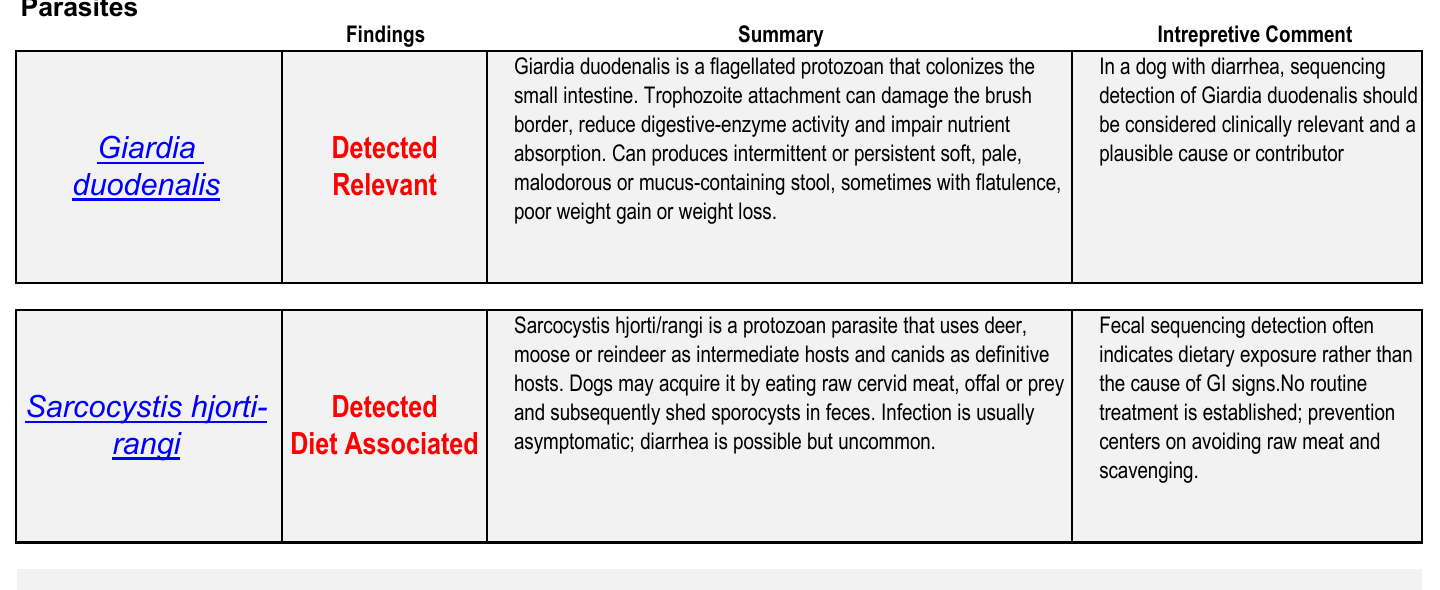
Example VDI Laboratory GI Microbiome parasite results
Sample parasite results. Click to view the complete GI Microbiome + Parasite sample report.
Detection With Context

Not every detection means the same thing.

Detecting parasite DNA is only part of the answer. VDI reporting adds interpretive context to help the veterinarian determine how a finding fits the patient’s history, diet and clinical signs.

Giardia duodenalis Detected · Relevant
In the sample case, Giardia is interpreted as a clinically relevant finding in a dog with diarrhea.
Sarcocystis hjorti/rangi Diet Associated
A second parasite detection is interpreted in the context of raw dietary exposure rather than automatically being assigned as the cause of the patient’s GI signs.

Open the complete sample report to review the original laboratory presentation and interpretive comments at full size.

Why NGS?

A broader way to investigate the parasite question.

Test code 740p uses next-generation sequencing and taxonomic profiling to evaluate parasitic and protozoan DNA in the submitted fecal sample.

NGS Next-generation sequencing for molecular parasite analysis.
1
Includes familiar canine and feline parasites Commonly recognized organisms are evaluated alongside a broader parasite reference set.
2
Molecular detection through sequencing Parasite DNA is evaluated through sequencing and taxonomic comparison.
3
Results require clinical context Detection should be considered alongside signs, exposure history, diet and other diagnostic findings.
Quick Details

Easy to add without slowing down the workup.

Turnaround
Same workflow — or same day
When ordered with the GI Microbiome Panel, parasite results follow the same turnaround as the microbiome panel. If 740p is added after the GI Microbiome Panel has already been completed, parasite results are available the same day.
Post-Submission Add-On Window
Up to 1 month
Test code 740p can be added to the original submitted GI Microbiome sample for up to one month after submission.
How to Order

Simply request test code 740p.

Parasite testing is offered as an add-on to VDI’s GI Microbiome Panel. No additional specimen is required.

1
Submit the GI Microbiome Panel Collect the standard VDI Microbiome Collection Kit fecal sample.
2
Request 740p Add parasite analysis when it is part of the initial diagnostic workup. Results follow the same turnaround as the GI Microbiome Panel.
3
Or add it within 1 month If the GI Microbiome Panel has already been completed, contact VDI to add 740p. Parasite results are available the same day.
Test code 740p is currently offered only as an add-on to the GI Microbiome Panel and is not available as a standalone VDI test.
Frequently Asked Questions

Parasite Testing FAQs

Can 740p be ordered as a standalone parasite test?
No. VDI currently offers test code 740p only as an add-on to the GI Microbiome Panel.
Is another stool sample required?
No. Parasite analysis uses the same fecal sample submitted for the GI Microbiome Panel.
Can I request parasite testing after the GI Microbiome Panel has been completed?
Yes. Test code 740p can be added for up to one month after the original GI Microbiome submission. If the GI Microbiome Panel has already been completed, parasite results are available the same day.
What is the turnaround time?
When 740p is ordered at the same time as the GI Microbiome Panel, parasite results follow the same turnaround as the microbiome panel. When added after the GI Microbiome Panel has already been completed, parasite results are available the same day.
Which patients can be tested?
VDI’s 740p parasite add-on is intended for canine and feline patients.
Does the test include the parasites veterinarians commonly encounter in canine and feline GI cases?
Yes. The parasite analysis includes familiar organisms such as Giardia, Cryptosporidium, Cystoisospora, Tritrichomonas, Toxoplasma, hookworms, roundworms, whipworms and tapeworms. Examples include Ancylostoma, Toxocara, Toxascaris, Trichuris, Dipylidium, Taenia and Echinococcus species. NGS also allows the investigation to extend beyond these familiar organisms to a broader eukaryotic parasite reference set.
Does detection of parasite DNA prove that the organism is causing the patient’s signs?
No. Molecular detection may represent clinically relevant infection, shedding, dietary exposure or environmental exposure depending on the organism and case. Results should be interpreted alongside clinical signs, history, diet, exposure risk and other diagnostic findings.
Does this replace every other method of parasite testing?
No single testing method is appropriate for every clinical question. NGS-based parasite analysis provides a broad molecular approach to parasite investigation. Complementary testing may still be appropriate depending on the organism suspected, the clinical presentation and the information needed for the case.

Expand the GI workup without asking the client for another sample.

When parasites remain part of the differential, add test code 740p to the VDI GI Microbiome Panel.

Laboratory findings should be interpreted in conjunction with the patient’s clinical signs, medical history, diet, exposure history and other diagnostic findings. Laboratory testing alone does not establish a definitive diagnosis.