

With current shortages and delayed availability of PTHrP testing across the industry, many clinicians are reassessing the role of single-marker testing in hypercalcemic and suspected neoplastic cases — and recognizing the value of broader physiologic and functional assessment to support clinical decision-making.
At VDI Laboratory, we want to remind you that while PTHrP can support suspicion for humoral hypercalcemia of malignancy, it has important clinical limitations:
- Many cancers do not produce PTHrP
- Some hypercalcemic cancer patients may still have normal PTHrP results
- A negative PTHrP does not rule out malignancy

So while PTHrP can provide supportive information in select cases, it reflects only one paraneoplastic mechanism and may be normal in many cancer patients. As a result, clinicians are increasingly seeking diagnostic approaches that provide more comprehensive insight into calcium regulation, cellular proliferation, systemic inflammation, and overall neoplastic activity.
That’s why VDI emphasizes a more clinically integrated approach.
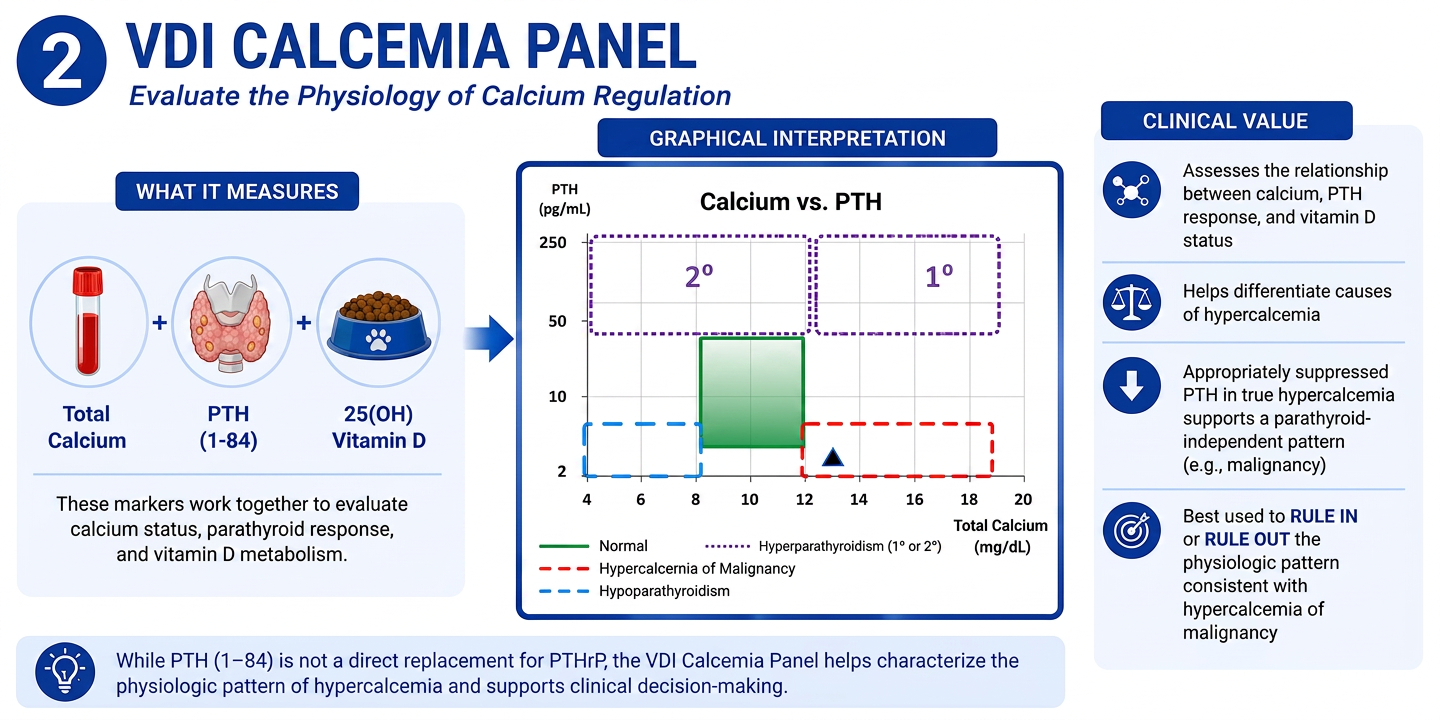
The VDI Calcemia Panel
Rather than relying on a single paraneoplastic marker, the VDI Calcemia Panel evaluates the physiologic pattern of calcium regulation by measuring:
- Total Calcium
- PTH (1-84)
- 25(OH) Vitamin D
The panel interprets the relationship between calcium status, parathyroid response, and vitamin D metabolism to help distinguish:
- Hypercalcemia of malignancy
- Primary hyperparathyroidism
- Vitamin D toxicosis
- Other parathyroid-independent causes of hypercalcemia
In true hypercalcemia, appropriately suppressed PTH supports a parathyroid-independent pattern — commonly associated with malignancy, including:
- Lymphoma
- Apocrine gland anal sac adenocarcinoma
- Multiple myeloma
Importantly, this physiologic approach remains valuable even when PTHrP is unavailable or negative.
The VDI Cancer Panel
When neoplasia is suspected — whether hypercalcemia is present or not — the VDI Cancer Panel provides broader functional insight by evaluating:
- TK1 (cellular proliferation marker)
- Canine CRP or Feline Haptoglobin (systemic inflammatory markers)
This panel helps clinicians:
- Rule in suspicion for neoplasia
- Monitor disease progression
- Follow response to therapy
- Support clinical decision-making when imaging or cytology is inconclusive
Unlike PTHrP, which reflects only one specific paraneoplastic mechanism, the VDI Cancer Panel evaluates broader biologic activity associated with cancer.

When to Consider VDI Testing
Consider the VDI Calcemia and Cancer Panels when:
✓ You want broader physiologic and functional insight beyond a single marker
✓ Serial monitoring for therapeutic efficacy or disease progression is needed
✓ Hypercalcemia is present but the cause remains unclear
✓ PTHrP testing is unavailable
✓ PTHrP results are negative despite strong clinical suspicion
Our goal is not simply to replace a test — it’s to provide more clinically actionable information for complex cases.
To learn more about the VDI Calcemia Panel or VDI Cancer Panel, or contact our team.